
The UAE private sector space missions are set to grow as the government plans to give local companies a larger role in the country’s ambitious space journey. Top officials have confirmed that more contracts will be awarded to private firms in the coming years.
This move is part of a broader strategy to grow the UAE’s space economy, encourage local innovation, and support national capabilities in high-tech industries.
UAE’s Space Journey: From Government to Private Hands
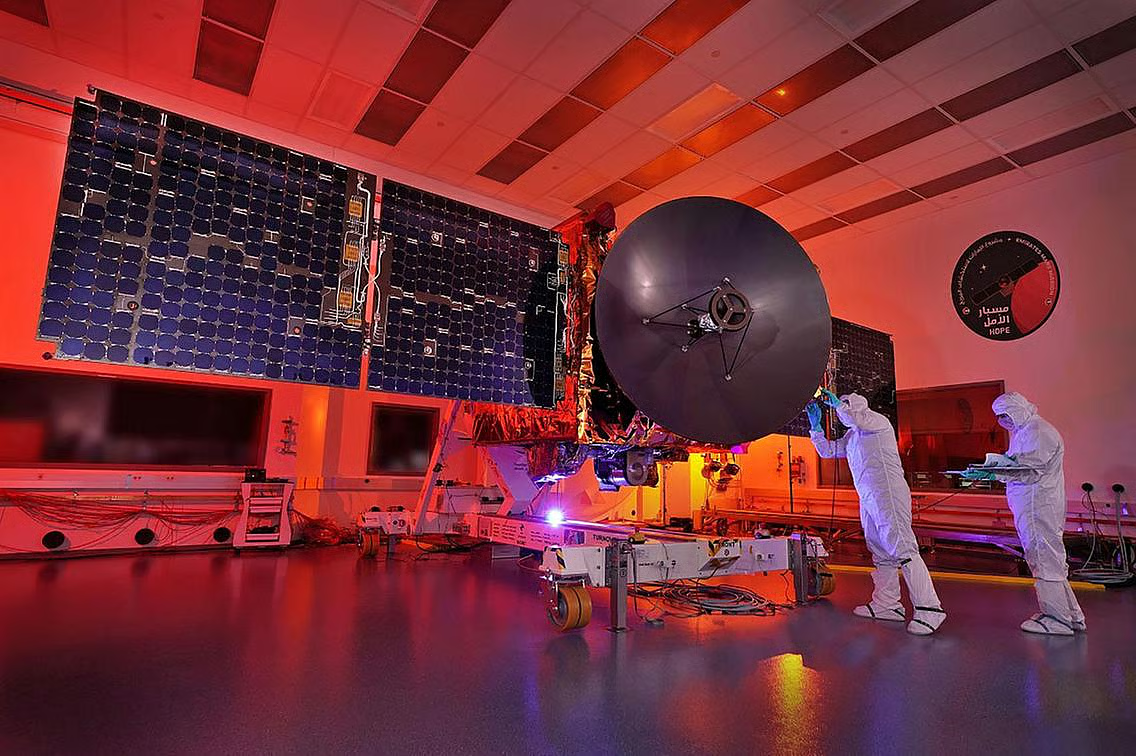
The UAE has made major strides in space in recent years. It launched the Hope Probe to Mars, sent astronauts to space, and developed advanced satellites. Until now, most of these efforts have been led by government-backed agencies such as the Mohammed bin Rashid Space Centre (MBRSC).

But things are changing. UAE officials now say that private companies will play a bigger part in future space missions.
Salem Al Marri, Director General of the MBRSC, said the country is working on “deepening the ecosystem” to bring in more private players and startups. The goal is to have a strong partnership between the public and private sectors.

More Contracts for UAE Firms in Space Sector
To make this vision a reality, the UAE will award more contracts to local private firms. These contracts will cover a range of services, such as:
- Building satellites
- Providing launch support
- Data processing and analytics
- Developing new space technologies
Al Marri said the government has already started working with some private companies and will “scale that up.”
He also stressed that it’s not just about big companies. “We are talking to startups and smaller players as well,” he added.
Creating a Thriving Space Economy in the UAE

One of the key goals behind this plan is to create a thriving space economy.
The UAE wants to become a global hub for space science, research, and technology. To achieve this, the country is focusing on:
- Building local talent through education
- Offering incentives for private firms
- Developing clear regulations and licensing rules
- Encouraging foreign companies to invest and collaborate
Ibrahim Al Qasim, Deputy Director General of the UAE Space Agency, said that empowering the private sector is “the only way to build a sustainable space economy.”
Private Sector Role in UAE’s Moon and Mars Plans
The private sector will also play a key role in some of the UAE’s most ambitious future missions.
The UAE plans to launch a spacecraft to explore the asteroid belt between Mars and Jupiter. It also has plans for a lunar rover and future Mars missions.
Officials say private firms could be involved in:
- Designing spacecraft parts
- Developing software and AI tools
- Managing data and communications systems
- Supporting mission logistics
This could open up huge business opportunities for local companies.
Global Interest in UAE’s Private Space Push
The UAE’s new strategy has already attracted global attention.
Several foreign space firms and tech companies have shown interest in partnering with the UAE’s private sector. With clear laws and government support, the UAE offers a business-friendly environment for space-related activities.
During a recent industry event, international space experts praised the UAE for encouraging private-sector participation and creating an “open and collaborative” space program.
Challenges and the Way Forward
While the outlook is promising, there are challenges. Building a mature private space sector takes time, investment, and skilled talent.
Some of the key challenges include:
- High cost of research and development
- Competition from global space giants
- Need for advanced infrastructure
- Managing risks in space operations
But UAE officials remain optimistic. “We are taking a step-by-step approach,” Al Qasim said. “We are learning from global best practices while focusing on our local needs.”
Education and Talent Development Are Key
For the UAE to achieve its goals, it must also develop a strong local workforce.
The country has already launched several space education programs in schools and universities. These programs aim to inspire young Emiratis to pursue careers in science, technology, engineering, and math (STEM).
Al Marri said the future of UAE’s space missions depends on its youth. “We want to create a generation that not only dreams big but also has the skills to build those dreams,” he said.
UAE’s Vision for a Self-Reliant Space Sector
In the long run, the UAE wants its space sector to be self-reliant. That means not only launching missions from its own territory but also designing, building, and operating spacecraft with local expertise.
The government’s latest move to empower private companies is a big step in that direction.
Officials say the UAE is working on a national strategy for space sustainability and economic development. The plan includes long-term investment in innovation, talent, and local companies.
Conclusion: A Bold Step Toward the Future
The decision to increase private sector role in UAE space missions is a bold and forward-thinking step.
It not only supports the country’s ambitious space goals but also helps build a stronger, more diversified economy.
By awarding more contracts and encouraging private innovation, the UAE is laying the foundation for a world-class space industry led by both government and private players.
The future looks promising—for the UAE and for any business ready to shoot for the stars.
Read More: UAE Mobile Police Station With EV Drone Tech to Hit the Roads