
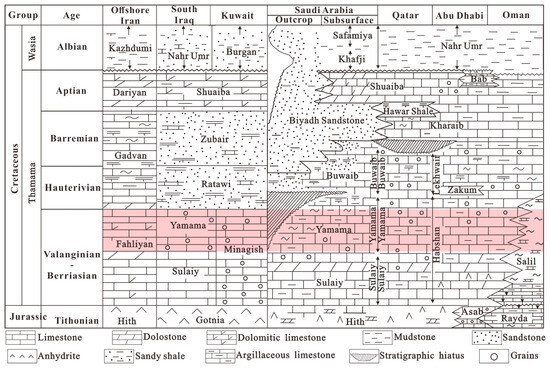
The Thamama Formation is one of the most significant carbonate petroleum reservoirs in the Middle East. Located primarily in the United Arab Emirates (UAE), Oman, and parts of Saudi Arabia and Qatar, this formation is a crucial contributor to the region’s oil and gas production. Its rich deposits, primarily made up of limestone and dolomite, have been a major driver of economic growth in the UAE.
This article explores the geological composition, hydrocarbon potential, economic significance, and future prospects of the Thamama Formation, highlighting its crucial role in the global energy landscape.
Geological Overview of the Thamama Formation
1. Formation and Age
The Thamama Formation was formed during the Early Cretaceous period, approximately 145 to 100 million years ago. It belongs to the Thamama Group, a sequence of sedimentary rocks that were deposited in a shallow marine environment.

2. Composition and Structure
- The formation primarily consists of limestone, dolomite, and some shale layers.
- It has a high porosity and permeability, making it an excellent reservoir for hydrocarbons.
- The Thamama Formation is divided into several sub-units, including the Kharaib, Lekhwair, and Shuaiba formations, which contain varying degrees of oil and gas deposits.
3. Regional Distribution
- The formation extends across the Arabian Peninsula, covering parts of the UAE, Oman, Saudi Arabia, and Qatar.
- It is a major oil-bearing formation in Abu Dhabi, with significant deposits found in fields such as Bab, Bu Hasa, Shah, and Asab.
- The onshore and offshore oil fields in the UAE heavily rely on hydrocarbon extraction from the Thamama Formation.
Hydrocarbon Potential and Petroleum Reserves
The Thamama Formation is known for its large oil and gas reserves, making it one of the most productive petroleum systems in the Middle East.
1. Oil Reserves
- The formation contains both light and heavy crude oil, which is extracted using conventional and enhanced recovery techniques.
- Major oil fields in Abu Dhabi, such as Bu Hasa and Bab, have significant Thamama reservoirs.
- The high-quality carbonate rocks enhance oil flow, making extraction relatively efficient.
2. Natural Gas Deposits
- The formation holds large deposits of natural gas, including sour gas (high sulfur content gas).
- ADNOC (Abu Dhabi National Oil Company) has launched major gas recovery projects to extract and process gas from Thamama reservoirs.
- The gas is used for power generation, industrial processes, and domestic consumption in the UAE.
3. Enhanced Oil Recovery (EOR) Methods
- Given the aging nature of some reservoirs, companies use EOR techniques like water flooding, CO₂ injection, and gas injection to maintain oil production.
- Carbon Capture and Storage (CCS) projects are being implemented to improve recovery rates while reducing environmental impact.
Economic Importance of the Thamama Formation
The oil and gas extracted from the Thamama Formation have played a key role in shaping the UAE’s economy.

1. Contribution to the UAE’s Oil Production
- The UAE is among the world’s top oil producers, with a significant portion of its crude oil coming from the Thamama Formation.
- The country exports millions of barrels daily, primarily to Asia, Europe, and North America.
2. Job Creation and Economic Growth
- The petroleum industry centered around Thamama supports thousands of jobs, from geologists and engineers to oilfield workers and environmental specialists.
- Revenues from oil production contribute to national projects, including infrastructure, education, and healthcare.
3. Investment in Advanced Technology
- The UAE has heavily invested in digital oilfield technology, including real-time monitoring systems, horizontal drilling, and automated extraction processes.
- ADNOC’s Thamama Subsurface Collaboration Center uses AI and big data to optimize oil and gas recovery.
Technological Innovations in Oil and Gas Extraction
1. Smart Drilling Technologies
- Horizontal and directional drilling techniques help maximize oil recovery while minimizing environmental impact.
- Automated monitoring systems provide real-time data on reservoir pressure, fluid levels, and production rates.
2. Carbon Capture and Sustainability Initiatives
- The UAE is implementing Carbon Capture, Utilization, and Storage (CCUS) to reduce emissions during oil and gas production.
- The Al Reyadah Carbon Capture Facility in Abu Dhabi captures CO₂ emissions and reinjects them into the Thamama reservoirs to enhance oil recovery.
3. Gas Processing and LNG Export
- ADNOC is expanding its gas production facilities, allowing the UAE to become a leader in Liquefied Natural Gas (LNG) exports.
- Investments in gas-to-power projects ensure energy security and economic diversification.
Future Prospects and Sustainability Goals
1. ADNOC’s 2030 Strategy
- ADNOC aims to increase oil production capacity to 5 million barrels per day by 2030.
- New exploration programs are being conducted to assess untapped reservoirs in the Thamama Formation.
2. Achieving Gas Self-Sufficiency
- The UAE is working towards natural gas self-sufficiency by 2030, using gas from Thamama to reduce LNG imports.
- Development of sour gas fields, such as the Hail and Ghasha projects, will contribute to this goal.
3. Transition to Renewable Energy
- The UAE plans to integrate renewable energy with traditional oil and gas operations.
- Future projects will include solar-powered extraction systems and hydrogen production linked to the Thamama reservoirs.
Conclusion
The Thamama Formation is a geological treasure that has shaped the UAE’s energy landscape for decades. Its vast oil and gas reserves, advanced recovery techniques, and strategic importance make it a cornerstone of Abu Dhabi’s petroleum sector.
With continuous technological advancements, sustainable energy initiatives, and expansion plans, the Thamama Formation will remain a crucial energy resource for years to come. As the UAE moves toward a more sustainable and diversified energy future, the role of Thamama will evolve, ensuring both economic prosperity and environmental responsibility.
Do follow Uae stories for more Updates
UAE Public Holidays 2025: Full List & How to Plan the Best Getaways