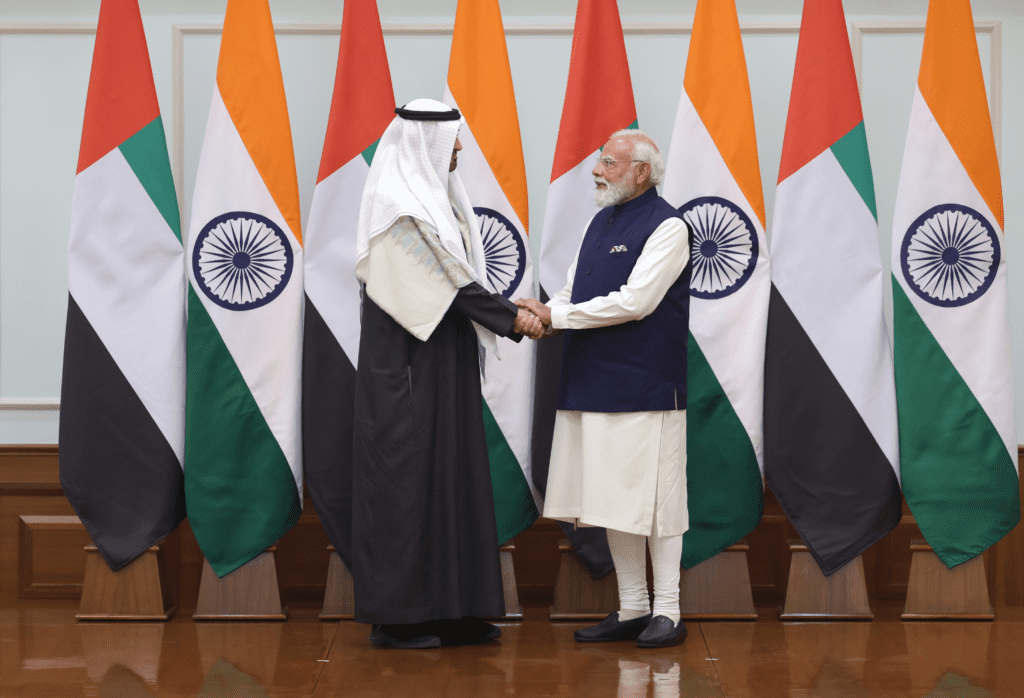
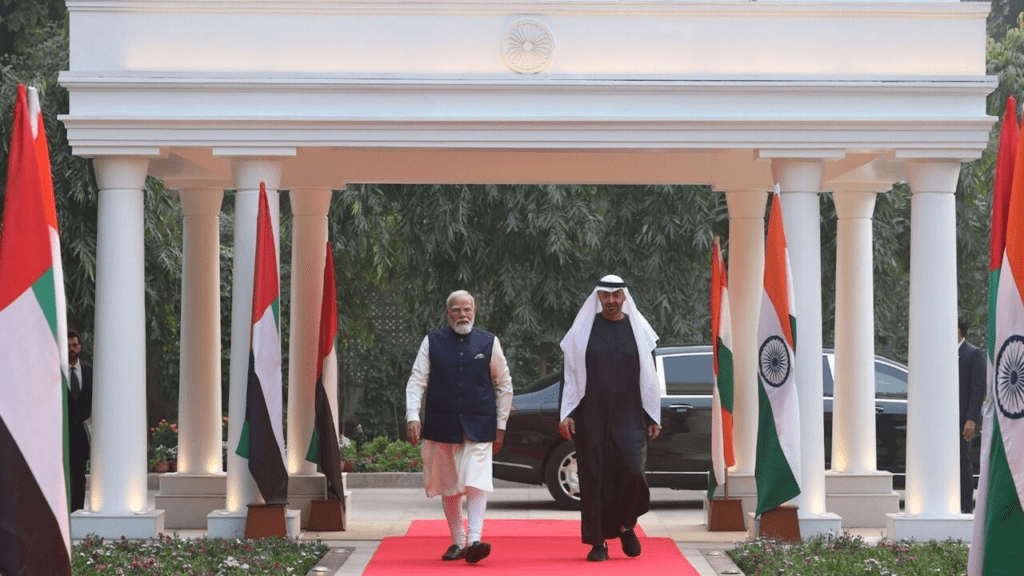
The state visit of Sheikh Mohamed bin Zayed Al Nahyan, President of the United Arab Emirates, to India marked a decisive moment in the evolution of the India–UAE Comprehensive Strategic Partnership. The visit, held in January 2026, reflected the growing convergence of interests between the two nations across investment, energy, defence, technology, food security, and people-to-people ties. The outcomes demonstrate not only political goodwill but also a shared ambition to build long-term, future-ready cooperation.
Strategic Investment in Dholera Special Investment Region
A major economic outcome of the visit was the signing of a Letter of Intent on Investment Cooperation between the Government of Gujarat and the Ministry of Investment of the UAE for the development of the Dholera Special Investment Region in Gujarat. This initiative envisions UAE partnership in building world-class strategic infrastructure, including an international airport, greenfield port, railway connectivity, energy infrastructure, a pilot training school, MRO facilities, and a smart urban township. The agreement signals strong confidence of UAE investors in India’s industrial corridors and positions Dholera as a future global manufacturing and logistics hub.
Expanding Space Sector Collaboration
India and the UAE also elevated cooperation in the space domain through a Letter of Intent between the Indian National Space Promotion and Authorisation Centre and the UAE Space Agency. The agreement focuses on joint infrastructure for space industry development and commercial collaboration. Planned initiatives include launch complexes, manufacturing and technology zones, incubation and accelerator centres for space start-ups, training institutes, and structured exchange programmes. This partnership underscores the complementary strengths of India’s cost-efficient space ecosystem and the UAE’s rapid investments in advanced technologies.

Towards a Strategic Defence Partnership Framework
Defence cooperation received renewed momentum with a Letter of Intent on establishing a Strategic Defence Partnership Framework. Both sides agreed to work together in defence industrial collaboration, innovation, advanced technologies, training and education, doctrine development, special operations, cyber space, counter-terrorism, and interoperability. The understanding reflects a shared commitment to regional stability and a recognition of evolving security challenges that require trusted partners and joint capabilities.
Long-Term LNG Supply Securing Energy Needs
Energy security featured prominently with the signing of a Sales and Purchase Agreement between Hindustan Petroleum Corporation Limited and ADNOC Gas. Under the agreement, HPCL will purchase 0.5 million metric tonnes per annum of LNG over a ten-year period starting from 2028. This long-term arrangement strengthens India’s clean energy transition while providing ADNOC Gas with a stable, high-growth market.

Strengthening Food Security and Agricultural Trade
An MoU on food safety and technical requirements was signed between APEDA under India’s Ministry of Commerce and Industry and the UAE Ministry of Climate Change and Environment. The agreement sets sanitary and quality parameters to facilitate smoother trade in rice, food products, and agricultural exports. It is expected to directly benefit Indian farmers while supporting the UAE’s food security strategy through reliable and diversified supply chains.
Supercomputing Collaboration Under AI India Mission
Among the key announcements was the in-principle agreement to establish a supercomputing cluster in India through collaboration between C-DAC India and G-42 of the UAE. The facility will form part of the AI India Mission and will be accessible to both public and private sectors for research, application development, and commercial use. This initiative highlights the shared vision of leveraging artificial intelligence and high-performance computing for economic and societal transformation.
Ambitious Trade Target of US$ 200 Billion
India and the UAE agreed to double bilateral trade to over US$ 200 billion by 2032. The strategy places strong emphasis on linking MSMEs, promoting new markets, and leveraging platforms such as Bharat Mart, the Virtual Trade Corridor, and Bharat-Africa Setu. This ambitious target reflects the success of the Comprehensive Economic Partnership Agreement and the mutual intent to diversify trade beyond traditional sectors.
Advancing Civil Nuclear Cooperation
The visit also opened new avenues in civil nuclear cooperation. Building on opportunities created by India’s SHANTI Act 2025, both sides agreed to explore partnerships in advanced nuclear technologies, including large nuclear reactors and Small Modular Reactors. Cooperation will extend to advanced reactor systems, nuclear plant operations and maintenance, and nuclear safety. This marks a significant step in clean energy collaboration with long-term strategic implications.
UAE Companies Expanding Presence in GIFT City
The setting up of offices and operations of UAE companies in GIFT City, Gujarat, was another important outcome. First Abu Dhabi Bank will establish a branch to promote trade and investment flows, while DP World will operate leasing services for ships supporting its global operations. These moves reinforce GIFT City’s emergence as a global financial and maritime services hub.
Exploring Digital and Data Embassies
Recognising the growing importance of digital sovereignty, both countries agreed to explore the establishment of Digital or Data Embassies under mutually recognised sovereignty arrangements. This forward-looking concept reflects trust at the highest level and addresses future needs in data protection, cloud infrastructure, and secure digital governance.
Cultural Diplomacy Through ‘House of India’ in Abu Dhabi
In a landmark cultural initiative, India and the UAE agreed in principle to establish a ‘House of India’ in Abu Dhabi. The proposed space will showcase Indian art, heritage, archaeology, and cultural traditions. This flagship project aims to deepen cultural understanding and celebrate the centuries-old civilisational links between the two societies.
Investing in the Youth and Future Generations
The two sides also agreed in principle to promote youth exchanges by arranging visits of youth delegations from both countries. These exchanges will foster academic collaboration, research partnerships, and cultural bonds, ensuring that the strategic partnership is carried forward by future generations with shared understanding and trust.
Conclusion
The January 2026 visit of President Sheikh Mohamed bin Zayed Al Nahyan to India delivered a comprehensive set of outcomes that span hard infrastructure, advanced technologies, energy security, defence, culture, and people-to-people engagement. Together, these initiatives reflect a mature, future-oriented partnership grounded in mutual respect, economic pragmatism, and strategic alignment. As India and the UAE look ahead, the outcomes of this visit provide a strong foundation for shared growth and regional stability.
Do follow UAE Stories on Instagram
Read Next – Exit Stamp Missing in UAE: Steps to Resolve the Issue Legally