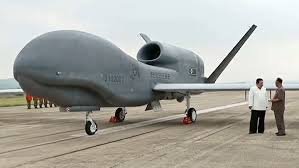
North Korea has reportedly conducted a test flight of its latest unmanned aerial vehicle (UAV), the Saetbyol-4, a reconnaissance drone that closely resembles the US-made RQ-4 Global Hawk. The development marks a significant advancement in Pyongyang’s drone capabilities and raises concerns about potential technological replication, regional security implications, and its impact on geopolitical tensions.
A Major Leap in North Korea’s Drone Program
According to reports, the Saetbyol-4 is the largest drone ever developed by North Korea. Its design appears remarkably similar to the RQ-4 Global Hawk, a high-altitude, long-endurance surveillance drone used by the United States. Experts believe this new drone represents Pyongyang’s efforts to bolster its reconnaissance and intelligence-gathering capabilities, which have traditionally relied on satellite launches and ground-based surveillance methods.
The test flight, conducted from an undisclosed airfield, reportedly showcased the drone’s ability to sustain long-duration flights and transmit real-time data. This suggests that North Korea is striving to improve its aerial reconnaissance capabilities, potentially enhancing its ability to monitor adversaries, including South Korea and US military installations in the region.

Technological Concerns and Speculation on Replication
Military analysts have pointed out the uncanny resemblance between the Saetbyol-4 and the Global Hawk, raising speculation that North Korea may have reverse-engineered or acquired design blueprints through cyber espionage or illicit trade networks. The drone features a sleek fuselage, long wingspan, and high-altitude operational capabilities, mirroring the specifications of the Global Hawk, which is known for its advanced radar and imaging systems.
While details about the Saetbyol-4’s avionics, sensor suite, and operational range remain undisclosed, analysts suggest that North Korea may have leveraged foreign technology to develop an advanced UAV. If confirmed, this would represent a strategic leap in Pyongyang’s military modernization efforts, allowing it to conduct persistent surveillance without relying solely on satellite technology.

Regional Security Concerns and Global Reactions
The test has sparked concerns among regional powers, particularly South Korea, Japan, and the United States. Seoul’s defense ministry has expressed caution, stating that it is closely monitoring North Korea’s advancements in drone technology. The concern is that an operational Saetbyol-4 fleet could enable Pyongyang to conduct long-range reconnaissance missions over the Korean Peninsula, potentially increasing the risk of military miscalculations.
The United States has not officially commented on the test but has previously warned about North Korea’s growing interest in UAV technology. Given the heightened military activity in the region, Washington may consider strengthening its intelligence-sharing efforts with South Korea and Japan to counter potential threats from North Korean surveillance drones.
Implications for North Korea’s Military Strategy
If the Saetbyol-4 proves to be an operational success, it could serve multiple strategic roles, including intelligence gathering, target tracking, and even potential strike capabilities if modified. North Korea has previously demonstrated its willingness to use drones for espionage, with multiple incidents of small UAVs infiltrating South Korean airspace in recent years.
Furthermore, the successful deployment of an advanced drone like the Saetbyol-4 could reduce North Korea’s reliance on satellite-based reconnaissance, which has been hampered by international sanctions limiting access to space-launch technology. This development could provide Pyongyang with a more cost-effective and flexible intelligence tool, further complicating security dynamics in East Asia.
Future Developments and Strategic Countermeasures
In response to North Korea’s drone advancements, South Korea and its allies may seek to enhance their counter-drone measures, including electronic warfare capabilities and air defense systems. The region has already seen an increase in anti-drone strategies, with South Korea actively working on developing drone interception technologies.
Meanwhile, global intelligence agencies are expected to analyze satellite imagery and reconnaissance data to assess the full capabilities of the Saetbyol-4. If North Korea is indeed progressing toward the mass production of these UAVs, it could lead to further sanctions and diplomatic pressures aimed at curbing its access to advanced military technologies.
As the situation unfolds, all eyes remain on Pyongyang’s next move. The successful development and deployment of high-end drones like the Saetbyol-4 could redefine North Korea’s military strategy, intensify regional tensions, and challenge global security frameworks.
Do follow Uae stories for more Updates
Why Patients Are Rushing to This UAE Hospital for World-Class Treatment!