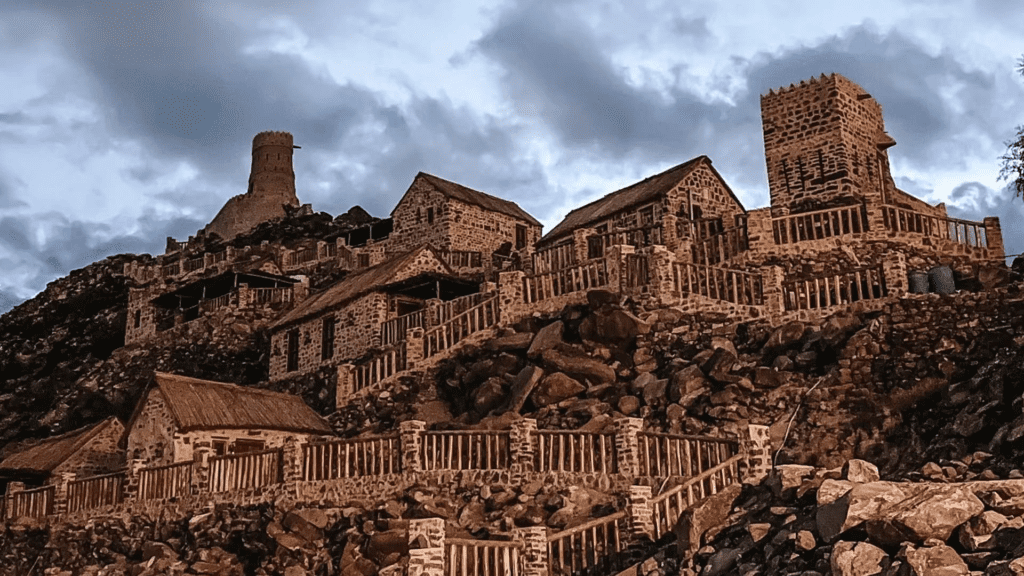
Nestled high in the rugged mountains overlooking the eastern coast of the United Arab Emirates, Najd Al Maqsar stands as a powerful reminder of resilience, strategy, and community life in pre-oil Arabia. This historic mountain village is located above the coastal city of Khor Fakkan, within the emirate of Sharjah. Surrounded by steep slopes and dramatic valleys, Najd Al Maqsar reflects centuries of human adaptation to harsh geography and shifting political realities.
Archaeological and historical records indicate that Najd Al Maqsar was inhabited continuously from the early medieval period and reached strategic importance between the 15th and 18th centuries, when regional trade routes and coastal defense became central to survival in eastern Arabia.
Geographic Setting and Strategic Importance
Najd Al Maqsar occupies a commanding position in the Hajar Mountains, approximately 300 meters above sea level. From this vantage point, residents could observe movement along the coast of the Gulf of Oman and inland mountain passes simultaneously. This elevated location was not accidental; it was chosen to protect the community from coastal raids and to control access routes between the interior and the sea.

During the 1500s, the eastern coastline became a contested zone due to increasing maritime activity. The mountain setting of Najd Al Maqsar offered natural defense at a time when regional powers and foreign fleets sought dominance over trade corridors linking India, East Africa, and Arabia.
Historical Background and Early Development
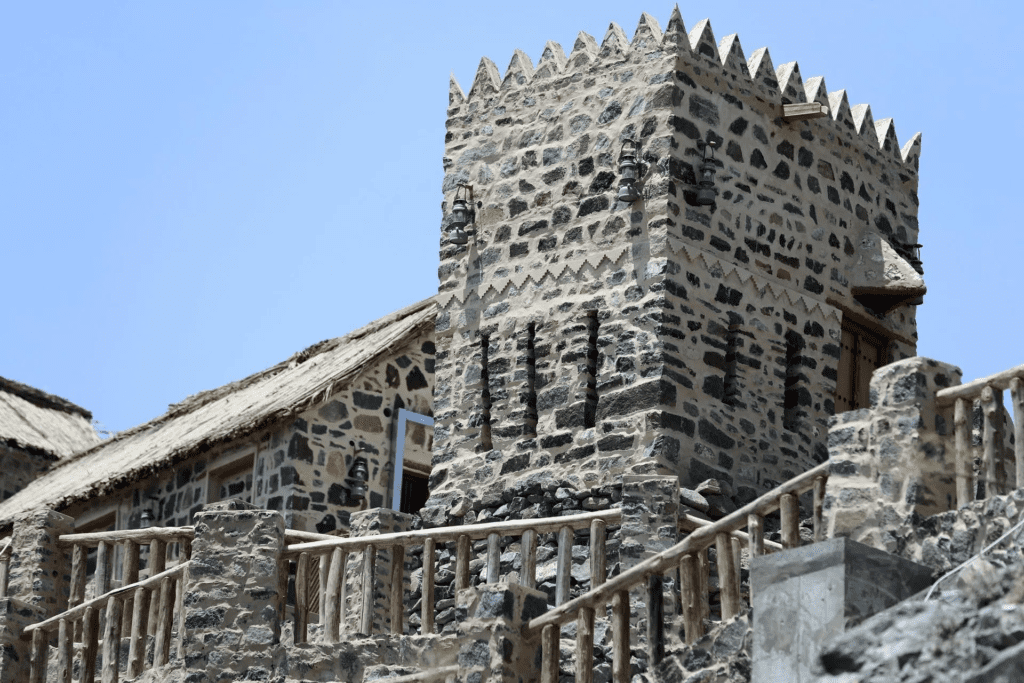
The settlement of Najd Al Maqsar is believed to predate the 14th century, with oral histories suggesting even earlier occupation. By the late 1400s, it had developed into a fortified mountain village consisting of stone houses, watchtowers, and communal storage areas. These structures were built using locally sourced stone and mud mortar, designed to withstand both climate extremes and armed conflict.

In 1507, the arrival of the Portuguese Empire in the Gulf region dramatically altered coastal dynamics. Portuguese forces established strongholds along the coast, including in Khor Fakkan, which made mountain settlements like Najd Al Maqsar essential refuges for local populations resisting foreign control. Throughout the 16th century, the village functioned as a defensive outpost and safe haven during periods of coastal occupation.
Architecture and Village Layout
The architecture of Najd Al Maqsar reflects both practicality and social organization. Houses were constructed in compact clusters, often sharing walls to conserve space and provide structural strength. Most homes were two or three stories high, with lower levels used for storage and livestock, and upper levels reserved for family living spaces.
A central fortification tower dominated the village skyline. This tower served as a lookout and communication point, where fires or signals could warn coastal settlements of approaching danger. Narrow pathways connected homes, intentionally designed to slow intruders and provide defensive advantage during attacks.
The village also included a small mosque, indicating the central role of religion in daily life. Its simple design emphasized function over ornamentation, aligning with the austere environment in which residents lived.
Daily Life and Community Structure
Life in Najd Al Maqsar was shaped by cooperation and resourcefulness. Families relied on terraced agriculture along mountain slopes, cultivating crops such as dates, millet, and seasonal vegetables. Rainwater harvesting systems and natural springs supported limited farming and household needs.
Fishing and trade remained important despite the village’s elevation. Residents frequently traveled down to Khor Fakkan to exchange agricultural produce for fish, salt, and imported goods. This close relationship between mountain and coastal communities created a balanced economic system that endured for generations.
Social life revolved around extended families and tribal affiliations. Decision-making was communal, with elders playing a key role in resolving disputes and organizing defense. This collective structure ensured survival in a region where isolation and environmental challenges demanded unity.
Decline and Abandonment
By the late 1800s, Najd Al Maqsar began to experience gradual decline. Improved security along the coast, reduced foreign threats, and changing economic conditions encouraged families to relocate closer to the sea. The expansion of Khor Fakkan as a port town offered better access to trade, education, and later, modern infrastructure.
By the early 20th century, most residents had permanently moved downhill, leaving Najd Al Maqsar largely abandoned. However, the village was never forgotten. Its ruins remained a visible reminder of earlier ways of life and the strategic thinking that once defined the region.

Preservation and Cultural Significance
In the early 2000s, heritage authorities in Sharjah recognized Najd Al Maqsar as an important cultural and historical site. Restoration efforts focused on stabilizing remaining structures and preserving the original layout without altering its character. These efforts aimed to protect the village as a living archive rather than transform it into a modernized attraction.
Today, Najd Al Maqsar is visited by historians, hikers, and cultural tourists interested in understanding pre-modern Emirati life. The site offers rare insight into mountain settlement patterns that differ significantly from the more commonly known desert and coastal communities of the UAE.
Najd Al Maqsar in the Modern Narrative
Najd Al Maqsar holds a unique place in the national story of the United Arab Emirates. While skyscrapers and global cities dominate contemporary imagery, this mountain village represents endurance, adaptation, and local ingenuity. It reminds visitors that the nation’s foundations were built not only on trade and pearls, but also on strategic knowledge of land and community solidarity.
The village’s continued preservation ensures that future generations can physically experience a chapter of history that textbooks alone cannot convey. Walking through its stone pathways offers a powerful connection to lives shaped by patience, courage, and deep understanding of the natural world.
Conclusion
Najd Al Maqsar is more than a collection of ruins; it is a testament to human resilience in one of the most challenging landscapes of eastern Arabia. From its strategic rise during the 15th and 16th centuries to its quiet decline and modern rediscovery, the village tells a story of survival, foresight, and cultural identity. As preservation efforts continue, Najd Al Maqsar remains a silent yet powerful guardian of the past, overlooking the coast it once protected.
Do follow UAE Stories on Instagram
Read Next – Sheesh Park Is Patiala’s Most Beautiful Secret Escape