

Historic Launch Marks UAE’s Global Space Leadership
The United Arab Emirates has achieved a remarkable milestone in space exploration with the successful launch of the PHI-1 satellite aboard Elon Musk’s SpaceX Falcon 9 rocket. Lifted off from Vandenberg Space Force Base in California, USA, the launch represents a major step forward in the UAE’s mission to democratize access to space and enable global collaboration in space technology. The PHI-1 satellite is the first modular satellite developed under the UAE’s Payload Hosting Initiative (PHI) in partnership with the United Nations Office for Outer Space Affairs (UNOOSA).
The satellite launch reflects the UAE’s commitment to expanding participation in space science, research, and technological innovation. By opening access to international partners, the mission strengthens global collaboration and positions the UAE as a hub for space research and technology development.
Empowering Nations Through Space Innovation
PHI-1 is more than just a satellite; it is a symbol of the UAE’s vision to make space technology accessible to nations, organizations, and educational institutions worldwide. The satellite carries payloads from multiple international partners, including the Bahrain Space Agency, Antarikchya Pratisthan Nepal, MBRSC, and the Sharjah Academy for Astronomy, Space Sciences and Technology (SAAST). Each payload serves a unique purpose, ranging from technology demonstrations to educational experiments, allowing global participants to test their innovations in orbit.

Amer AlSayegh AlGhaferi, Assistant Director General of the Aerospace Engineering Sector at MBRSC, highlighted the mission’s significance, stating that it embodies the UAE’s vision of empowering nations and organizations with hands-on opportunities to develop and test space technologies. The collaborative mission reflects the UAE’s strategy of combining international partnerships with strong local engineering expertise.
Aarti Holla-Maini, Director of UNOOSA, emphasized the importance of inclusive projects like PHI-1, explaining that they reduce cost and risk for nations, foster skill development, and accelerate innovation that benefits people on Earth. She noted that initiatives such as PHI-1 are essential to transforming ambitious ideas into sustainable capabilities in space.

A Modular Satellite Platform for Global Innovation
PHI-1 is a 12U CubeSat designed to support a variety of technology demonstrations and research experiments. With an expected operational lifespan of one year, the satellite enables partner entities to conduct in-orbit testing, strengthen their engineering skills, and enhance their understanding of satellite data analysis and real-time mission operations.
The satellite’s diverse payload suite reflects its global collaborative mission. The Bahrain Space Agency’s AMAN payload focuses on testing Advanced Encryption Standard protocols to improve satellite communication security. Meanwhile, Antarikchya Pratisthan Nepal has contributed a LoRa Satellite System to examine how LoRa communication technology performs in orbit.
MBRSC’s New-Space Video Camera will capture high-definition images and videos to support technology validation, Earth observation, and educational outreach. The SAAST payload, designed by students, measures temperature and orientation in space, offering practical experience for the next generation of space scientists and engineers.
PHI-1 represents a clear step toward democratizing space, giving nations and organizations an opportunity to gain hands-on experience in satellite testing and innovation. By making space technology accessible, the UAE aims to build a more inclusive and collaborative space community.
Designed and Assembled in the UAE
The PHI-1 satellite was fully designed, assembled, and tested at MBRSC’s facilities in Dubai. Partner teams worked closely with MBRSC engineers throughout the development process, from concept and design reviews to testing and flight preparation. MBRSC ensured full mission assurance, making certain that every subsystem and payload met the highest standards for successful operation in space.
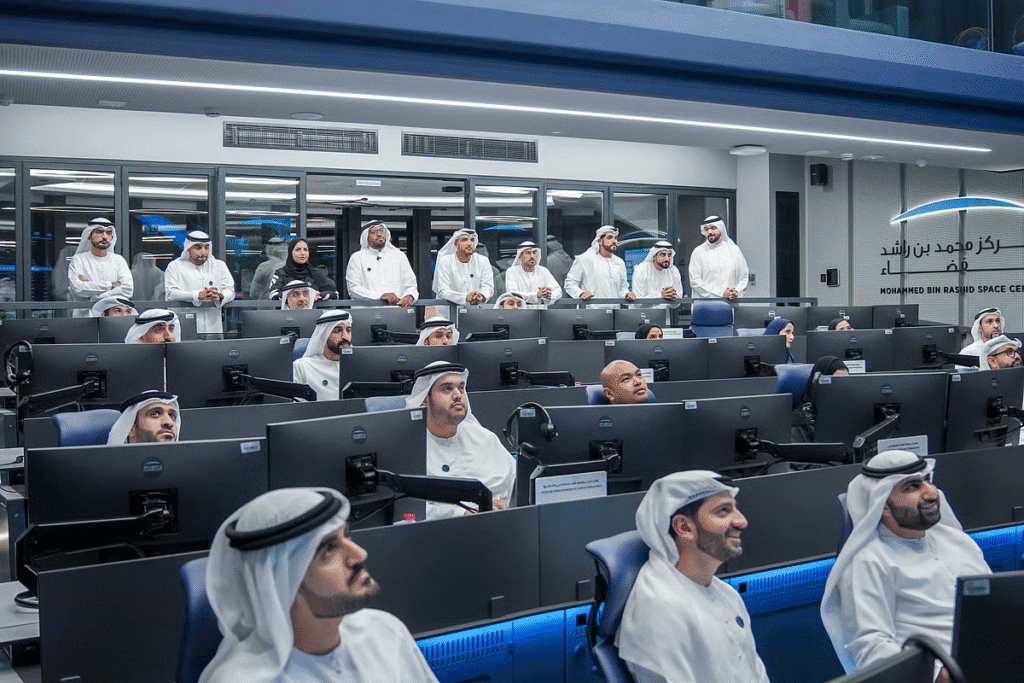
Once operational, the satellite’s data will be received at MBRSC’s Mission Control Centre and shared with participating organizations. This exchange of information will allow partners to advance their research, refine their technologies, and develop new scientific capabilities.
PHI-1 also aligns with the United Nations Sustainable Development Goals. By providing hands-on training, it contributes to Quality Education. Through innovation-led development, it promotes Decent Work and Economic Growth. Additionally, it expands access to space technology, supporting Industry, Innovation, and Infrastructure on a global scale.
The collaborative approach to designing and integrating PHI-1 ensures that each partner organization gains valuable experience in satellite engineering and mission operations. This hands-on involvement provides practical knowledge that can be applied to future space missions.
Advancing Global Space Collaboration
The successful launch of PHI-1 demonstrates the UAE’s growing role in the international space community. The mission highlights how national engineering capability combined with global partnerships can create meaningful opportunities for research, innovation, and education.
By enabling other nations to test and validate their technologies in space, the UAE is fostering a more inclusive and collaborative space ecosystem. PHI-1’s success strengthens international ties and empowers young scientists and engineers to contribute actively to space exploration.
The UAE’s achievements in space technology continue to inspire other nations, showcasing how strategic investments in engineering, education, and collaboration can transform ambitious ideas into tangible global contributions. As PHI-1 begins its journey in orbit, it opens new pathways for knowledge-sharing, research, and scientific innovation that will benefit humanity for years to come.
A Vision for the Future
PHI-1 is a significant step in the UAE’s ongoing efforts to democratize space access and nurture a global community of researchers, innovators, and students. By creating opportunities for collaborative experimentation, the UAE is not only advancing its national capabilities but also setting a benchmark for how countries can work together in space exploration.
The mission reflects the UAE’s commitment to fostering innovation, building skills, and promoting scientific excellence worldwide. It highlights the country’s dedication to sustainable and inclusive growth in space technology, ensuring that the benefits of exploration reach both Earth and beyond.
With PHI-1 in orbit, the UAE continues to establish itself as a global leader in space innovation, paving the way for a future where nations of all sizes can participate in advancing humanity’s understanding of the universe.
PHI-1 also demonstrates that space exploration is not limited to traditional spacefaring nations. Through partnerships, educational programs, and hands-on experience, the satellite is inspiring a new generation of engineers, researchers, and innovators to look to the stars and contribute to humanity’s journey beyond Earth.
The mission reinforces the UAE’s role as a gateway to space for emerging nations, promoting international cooperation and creating long-term opportunities for scientific advancement and technological progress.
Do follow UAE Stories on Instagram
Read Next – Environment Agency Abu Dhabi Announces Kingfish Second Spawning Season