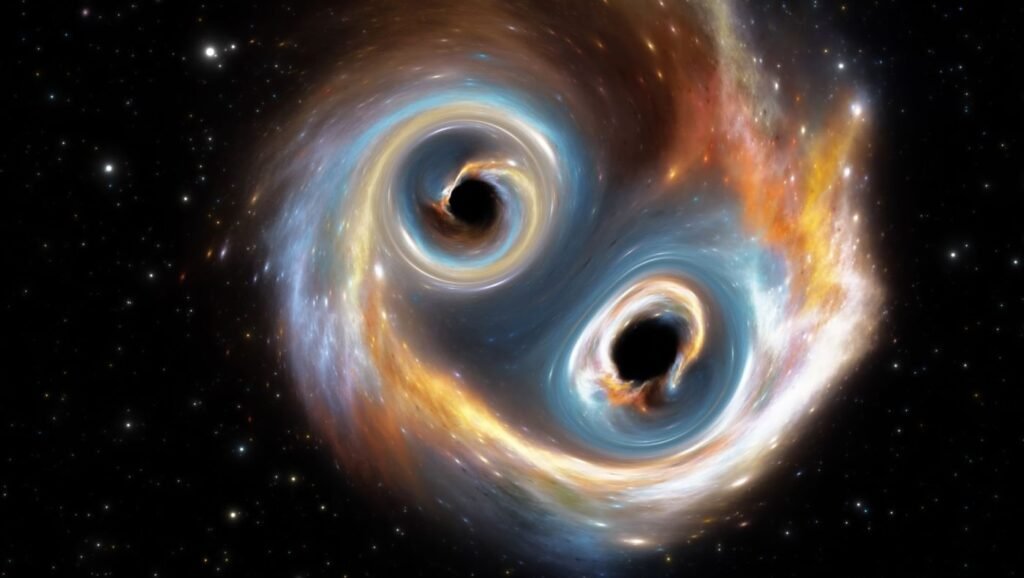
In a historic leap for astronomy, scientists have captured the first ever image of two black holes orbiting each other, a discovery that gives us an extraordinary glimpse into one of the universe’s most enigmatic phenomena. For decades, the idea of two supermassive black holes locked in a gravitational dance has intrigued scientists, but direct visual evidence has remained elusive until now.
This groundbreaking image reveals not just two black holes, but the dynamic and powerful interaction between them. Observing such a system helps us understand how black holes behave, how they affect their surrounding environment, and how they may eventually merge, producing phenomena like gravitational waves.
What the Image Shows
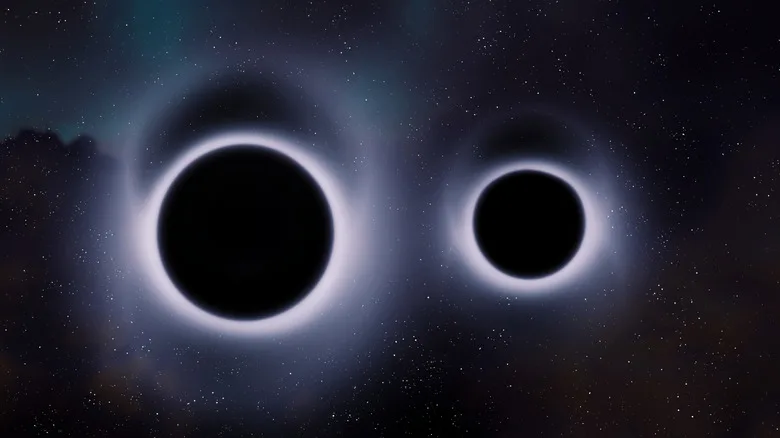
The image captures two supermassive black holes orbiting each other in a distant galaxy billions of light years away. Unlike stars, black holes cannot be seen directly because light cannot escape them. Instead, the image shows the glowing material surrounding the black holes and the energetic jets of particles being ejected at near light speed. These luminous signals allow astronomers to infer the presence, position, and movement of the black holes.

The larger black hole in the system is colossal, with a mass billions of times that of the Sun, while its smaller companion is still massive, weighing millions of solar masses. They orbit each other in a gravitational embrace, pulling in surrounding gas and dust and releasing immense energy in the process. This orbital motion creates patterns in the surrounding material that can be detected and imaged by powerful telescopes.
Why This Discovery Matters
Capturing the first ever image of two black holes orbiting is a major scientific milestone. For years, astronomers have relied on indirect observations, like gravitational waves or periodic changes in light from distant galaxies, to hypothesize the existence of binary black hole systems. Now, we have visual confirmation, which allows for direct study of how these cosmic giants interact.

Studying orbiting black holes provides insights into
Gravitational Dynamics
Understanding how black holes orbit one another reveals how gravity operates under the most extreme conditions. These insights refine our knowledge of Einstein’s theories and may lead to new physics.
Galaxy Evolution
Supermassive black holes are thought to reside at the center of nearly every galaxy. Observing how they interact in pairs can reveal how galaxies merge and evolve over billions of years.
Energy Jets and Accretion Disks
Observing the glowing material and jets surrounding black holes provides clues about the behavior of matter near these extreme objects, including how energy is released into space.
Future Mergers and Gravitational Waves
Binary black holes are expected to eventually collide, producing gravitational waves. Watching them orbit gives astronomers a preview of these dramatic cosmic events.
How the Image Was Captured
Capturing such an image requires extraordinary technology and precision. Astronomers used a combination of radio and space based telescopes to observe the system over time. By measuring the radiation emitted from the surrounding material and particle jets, they were able to reconstruct the structure and movement of the black holes.
This approach is similar to using indirect clues to map something that cannot be seen directly. The light from the surrounding gas and the behavior of particle jets act like cosmic fingerprints, revealing details about the black holes’ masses, spins, and orbital patterns. The image is a testament to modern astronomical techniques, including high resolution imaging, radio interferometry, and long term monitoring.
What It Teaches Us About Black Holes
Black holes are often misunderstood as simply empty voids, but they are incredibly active regions of space. Material falling into a black hole forms an accretion disk, heating up and emitting radiation before crossing the event horizon. In a binary system, this process is amplified. The two black holes’ gravitational interaction creates tidal forces that distort and accelerate the surrounding material, making it glow more brightly and producing energetic jets that shoot far into space.
By studying these features, scientists gain information about
The mass and size of each black hole
How material moves in extreme gravitational fields
How energy and radiation are emitted near black holes
The dynamics of binary systems before they eventually merge
Understanding these processes helps us answer fundamental questions about the universe, including the role of black holes in galaxy formation and the mechanisms behind some of the most powerful explosions and radiation sources in the cosmos.
Looking Ahead
While this discovery is monumental, it is just the beginning. Observing the first ever image of two black holes orbiting opens the door for further exploration and research:
Continuous Observation
Scientists will monitor these black holes over the coming years to track their orbit and predict future interactions, including the eventual collision.
Gravitational Wave Detection
As the black holes spiral closer together, they will generate gravitational waves, ripples in space time that can be detected on Earth. Observing these waves will provide additional insights into the properties of black holes and the nature of gravity.
Technological Advancements
The techniques used to capture this image will improve over time, enabling astronomers to observe similar systems in greater detail and perhaps even capture images of black holes at closer distances.
Public Engagement
Discoveries like this inspire curiosity and wonder about the universe. The image helps bring complex astrophysics to a wider audience and highlights the importance of scientific exploration.
Conclusion
The first ever image of two black holes orbiting each other is a monumental achievement, demonstrating humanity’s growing ability to observe and understand the universe. It transforms a theoretical concept into a visual reality, allowing scientists and the public alike to see these cosmic giants in action.
This discovery is more than just a scientific milestone; it is a reminder of the universe’s vast complexity and the power of human ingenuity. As telescopes become more advanced and our understanding of space deepens, we can look forward to uncovering even more remarkable phenomena that challenge our perceptions and expand the boundaries of knowledge.
The image of these two orbiting black holes represents not only a triumph of observation but also a symbol of humanity’s relentless curiosity and determination to understand the cosmos. It is a cosmic dance frozen in time, offering a glimpse of forces and events that have shaped the universe for billions of years and will continue to do so for eons to come.
Do follow UAE Stories on Instagram
Read Next – NYU Abu Dhabi Brain Implant Revolutionizes Drug Delivery