
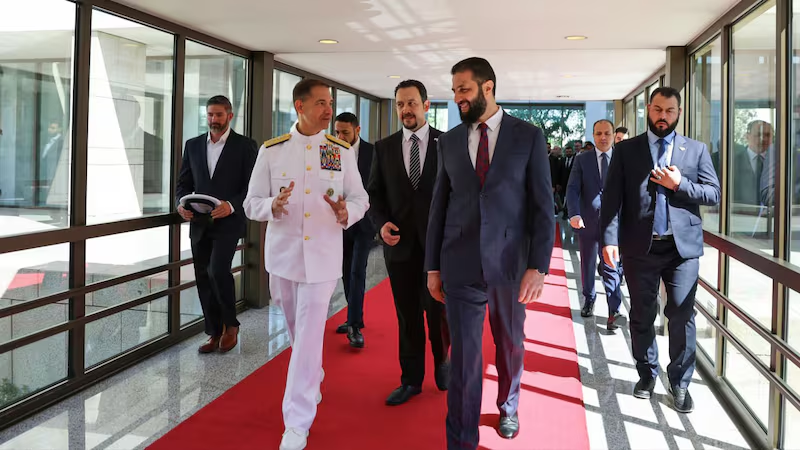
When the new Centcom chief meets Syrian President in Damascus, it becomes more than a diplomatic headline. It represents a shift in tone, a moment that could open doors to new understandings, and a sign of how regional and global politics are being reconfigured in real time. The Middle East has long been a stage where alliances shift, conflicts simmer, and great powers test strategies. Against this backdrop, a high-level meeting between the head of the U.S. Central Command (Centcom) and President Bashar al-Assad is bound to attract attention.
For many years, Damascus and Washington have been adversaries on almost every front. Yet, this rare direct engagement reflects the possibility that both sides, despite profound differences, might see value in dialogue. The encounter raises questions about U.S. strategy in Syria, the future of its troops, and the region’s shifting power balance.
This article explores the context, motivations, and possible outcomes of the meeting, while examining what it means for Syria, the United States, and the wider Middle East.

A Rare Encounter in Damascus
The announcement that the new Centcom chief meets Syrian President in Damascus caught many observers off guard. Since the outbreak of Syria’s civil conflict in 2011, the United States has been one of Assad’s fiercest critics, calling for political change and opposing his government’s actions. Washington has imposed sanctions, supported opposition groups, and stationed troops in northeastern Syria to fight terrorism.
Over the years, U.S. officials have avoided direct, high-profile engagement with Assad. Meetings, when they occurred, were usually through intermediaries or limited to narrow humanitarian discussions. The decision of a Centcom chief to travel to Damascus, sit with Assad, and discuss matters of regional and global importance is therefore a significant departure from the past.

The discussions reportedly touched upon:
• Regional security and stability in light of ongoing conflicts.
• Counterterrorism strategies against extremist groups still active in Syria.
• The presence of U.S. troops and their long-term role in the country.
• Humanitarian and reconstruction issues, given Syria’s devastated infrastructure.
Why This Meeting Matters
The meeting’s importance lies in both symbolism and substance. Symbolically, it breaks years of diplomatic silence at the highest levels. Substantively, it acknowledges that the U.S. cannot ignore Syria’s role in the region, regardless of political disagreements.
Several points underscore the significance:
- Direct U.S.–Syria Engagement
After years of minimal contact, this face-to-face meeting shows that Washington recognizes the need for dialogue with Damascus. - Middle East Realignment
The region is experiencing shifts as Syria is being welcomed back into Arab circles and new alliances are forming. The U.S. may be seeking to ensure it does not lose influence during this realignment. - Counterterrorism Imperatives
Extremist groups, though weakened, remain active in Syria. Both Washington and Damascus have an interest in containing these threats, even if they disagree on broader issues. - Debates on U.S. Troop Presence
Nearly 900 American troops remain deployed in northeastern Syria. Their mission and future role require discussions that inevitably involve Damascus.
The Long Road of U.S.–Syria Relations
Understanding the weight of the meeting requires looking at history.
During the Cold War, Syria often aligned itself with the Soviet Union, setting itself apart from U.S. allies in the region. In the decades that followed, Washington criticized Damascus for its ties with groups such as Hezbollah and its support for Iran.
The 2011 Syrian uprising marked the lowest point. As protests escalated into civil war, the United States demanded Assad’s removal, imposed sanctions, and provided political and limited material support to opposition groups. At the same time, Washington focused heavily on combating ISIS in Syria, deploying troops and working with local partners.
Despite hostility, moments of limited cooperation occurred. During the fight against ISIS, both sides indirectly targeted a common enemy. However, this cooperation remained fragile and did not translate into political dialogue. The fact that the new Centcom chief meets Syrian President in Damascus suggests a recognition that some level of engagement may now be unavoidable.
What Motivated the Centcom Visit?
Several factors likely influenced the decision:
• Reevaluating U.S. Troop Commitments
With debates intensifying in Washington about military deployments abroad, Syria is part of the conversation. A clearer picture of Assad’s stance could help shape U.S. decisions.
• Counterterrorism Needs
Extremist groups, though weakened, continue to operate. Direct talks could improve coordination, even if indirectly, to ensure such threats do not regain strength.
• Regional Shifts
Syria’s return to the Arab League and its outreach to Gulf states reflect a new chapter. Washington may feel isolated if it maintains complete disengagement.
• Balancing Iranian and Russian Influence
Syria’s reliance on Iran and Russia has deepened over the years. By opening a dialogue, Washington may hope to limit, even slightly, the sway of these actors.
Damascus’s Calculations
For Assad, the meeting offers more than just discussion.
• Political Legitimacy: Engaging directly with a top U.S. commander signals recognition of his government’s role, despite years of sanctions and isolation.
• Diplomatic Leverage: Assad can use the encounter to demonstrate that the U.S. acknowledges his influence, strengthening his position both domestically and internationally.
• Security Reassurance: For Syria, managing the presence of foreign troops is a delicate issue. Dialogue with Centcom may provide insights into U.S. plans.
Regional Reactions
The news reverberated across the Middle East.
• Russia and Iran: Both are Assad’s closest allies. They likely view the meeting with suspicion, wary of U.S. efforts to edge into their sphere of influence.
• Turkey: Ankara, heavily involved in northern Syria and concerned about Kurdish forces, may interpret U.S.–Syria contact as a sign of changing policies.
• Gulf States: Having recently restored ties with Damascus, Gulf countries may see the U.S. move as validation of their own outreach.
• Opposition Groups: For factions opposing Assad, the meeting is concerning, suggesting that Washington’s commitment to political transition is weakening.
Possible Outcomes
The meeting could produce a range of outcomes:
- Enhanced Counterterrorism Coordination
Practical steps could emerge against ISIS remnants, improving security in certain areas. - Discussions on U.S. Troop Presence
Any future withdrawal or redeployment would likely require at least indirect understanding with Damascus. - Humanitarian Pathways
The dialogue could create openings for aid delivery and rebuilding efforts, even in small ways. - Symbolic Impact
The meeting might remain symbolic, with little immediate change on the ground but significant long-term implications.
Barriers to Progress
Despite potential, obstacles are considerable.
• Deep Distrust: Years of hostility cannot be undone overnight.
• U.S. Domestic Politics: Any contact with Assad is sensitive in Washington, where many see engagement as legitimizing his rule.
• Lack of Political Settlement: The Syrian conflict remains unresolved, making sustained cooperation challenging.
• Foreign Influence: With Russia and Iran deeply entrenched in Syria, U.S. influence may be limited.
Could This Signal a Shift in U.S. Strategy?
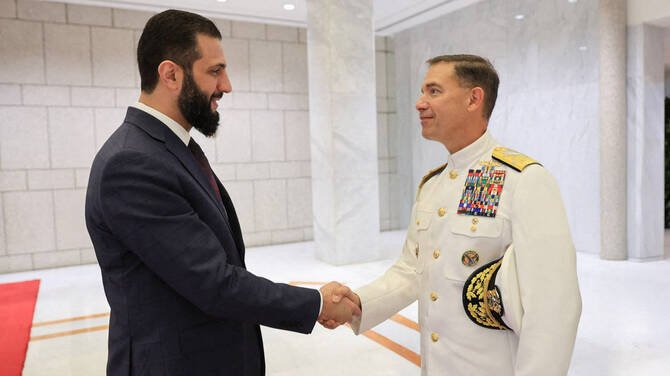
The fact that the new Centcom chief meets Syrian President in Damascus may suggest a gradual recalibration of Washington’s approach. For years, U.S. policy was rooted in isolating Assad and demanding change. That strategy has yielded little progress, while regional actors have moved ahead with their own engagement.
Now, the U.S. may be leaning toward a pragmatic approach: maintaining pressure where necessary, but opening channels where mutual interests align. This does not mean normalization of ties but rather a recognition that dialogue may serve U.S. security goals more effectively than silence.
Looking Ahead
Several questions remain:
• Will the meeting lead to regular communication or remain a one-time event?
• How will Russia and Iran respond to U.S.–Syria engagement?
• Can counterterrorism cooperation be expanded without political concessions?
• What does this mean for U.S. troops still deployed in Syria?
These questions highlight the uncertainties ahead. Still, the encounter signals that both sides, despite deep divides, recognize that silence is not an option.
Conclusion
The fact that the new Centcom chief meets Syrian President in Damascus is a turning point in U.S.–Syria relations. Whether it leads to meaningful policy changes or remains a symbolic gesture depends on how both governments choose to act in the months ahead.
At the very least, the meeting underscores the reality of modern geopolitics: in a region marked by complexity, even adversaries sometimes find it necessary to talk.
Do follow UAE Stories on Instagram
Read Next – Centara Grand Lagoon Hotel: A Blissful Island Hideaway